This system is based on the direction a body organ (e.g., the heart) would be displaced by acceleration. Table II in this figure (and in particular, system 4, which is based on displacement of body fluids) explains the most commonly employed terms.
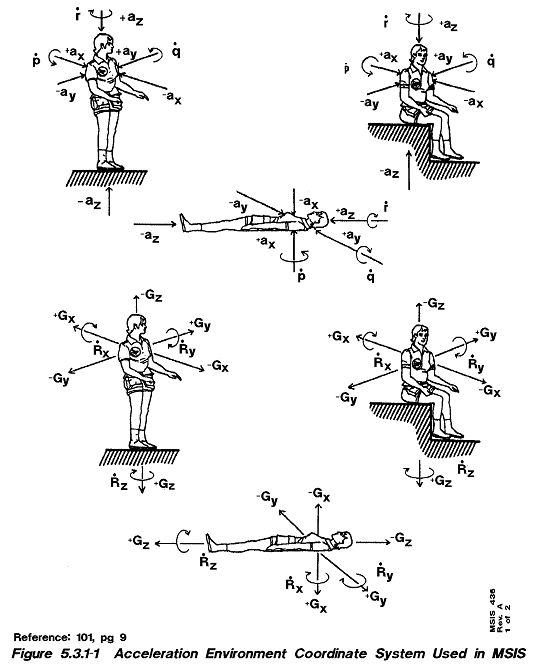
Reference: 101, NASA-STD-3000 436
| LINEAR MOTION | Direction of Acceleration | Inertial Resultant of Body Acceleration | ||
| Acting Force | Acceleration Description | Reaction Force | Verticular Description | |
|---|---|---|---|---|
| Forward | +ax | Forward accel. | +Gx | Eye Balls In |
| Backward | -ax | Backward accel. | -Gx | Eye Balls Out |
| Upward | -az | Headward accel. | -Gz | Eye Balls Down |
| Downward | +az | Foorward accel. | +Gz | Eye Balls Up |
| To Right | +ay | R. Lateral accel. | +Gy | Eye Balls Left |
| To Left | -ay | L. Lateral accel. | -Gy | Eye Balls Right |
| ANGULAR MOTION | ||||
| Roll Right | +p | -Rx | Cartwheel | |
| Roll Left | -p | +Rx | ||
| Pitch Up | +q | -Ry | Somersault | |
| Pitch Down | -q | +Ry | ||
| Yaw Right | +r | +Rz | Pirouette | |
| Yaw Left | -r | -Rz | ||
Reference: 380; NASA-STD-3000 435
Footnotes:
Large letter, G, used as unit to express inertial resultant to whole
body acceleration in multiples of the magnitude of the acceleration
of gravity.
Acceleration of gravity, g, = 980,665 cm/sec2 or 32.1739
ft/sec2.